
Election of the President of India
1. Introduction
The President of India is the head of the Union Executive and the first citizen of the country.
The office of the President is established under Article 52 of the Constitution.
Since India follows a parliamentary system, the President is the nominal head (de jure executive), while the Prime Minister and Council of Ministers exercise real power (de facto executive).
The method of election ensures that the President represents the collective will of the nation — both the Union and the States.
2. Constitutional Provisions
| Article | Subject |
|---|---|
| Article 52 | There shall be a President of India |
| Article 53 | Executive power of the Union |
| Article 54 | Election of the President |
| Article 55 | Manner of election of the President |
| Article 56 | Term of office of the President |
| Article 57 | Eligibility for re-election |
| Article 58 | Qualifications for election |
| Article 59 | Conditions of office |
| Article 60 | Oath or affirmation by the President |
| Article 61 | Procedure for impeachment |
3. Election Authority
The Election Commission of India (ECI), under Article 324, is responsible for conducting and supervising the election of the President.
4. Electoral College (Article 54)
The President is not directly elected by the people but by an Electoral College consisting of:
- Elected Members of both Houses of Parliament (Lok Sabha and Rajya Sabha).
- Elected Members of the Legislative Assemblies of the States (including Union Territories of Delhi and Puducherry, after the 70th Constitutional Amendment, 1992).
⚠️ Nominated members of Parliament and State Legislatures do not participate in the election.
5. Manner of Election (Article 55)
The election of the President is conducted by the system of proportional representation by means of the single transferable vote, and the voting is by secret ballot.
This ensures:
- Uniformity in the representation of the States.
- Parity between the States and the Union.
6. Value of Votes
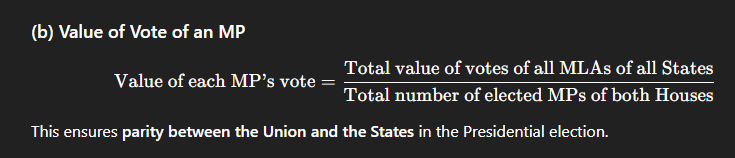
To maintain equality between the Union and States, the Constitution provides a formula for calculating the value of votes.

7. Voting Procedure
The election is held in accordance with the Presidential and Vice-Presidential Elections Act, 1952, and the Rules of 1974.
Step 1: Nomination
- A candidate must be proposed by at least 50 electors and seconded by 50 electors from the Electoral College.
- A security deposit of ₹15,000 is required (forfeited if the candidate fails to secure one-sixth of total valid votes).
Step 2: Voting
- Secret ballot system — free from party whip.
- Proportional representation with single transferable vote (STV):
- Each voter marks preferences (1, 2, 3, etc.).
- Counting is done in rounds until a candidate secures the quota of votes (majority).
Step 3: Counting of Votes
- Votes are counted based on preferences.
- The candidate who secures more than 50% of the total valid votes (in value terms) is declared elected. Click Here
8. Qualifications for Election (Article 58)
To be eligible for election as President, a person must:
- Be a citizen of India.
- Have completed 35 years of age.
- Be qualified to be elected as a member of the Lok Sabha.
- Not hold any office of profit under the Government of India, any State, or any local authority.
(However, office of President, Vice-President, Governor, or Minister is not considered an office of profit.)
9. Oath or Affirmation (Article 60)
Before entering office, the President must take an oath or affirmation administered by the Chief Justice of India, or in his absence, the senior-most judge of the Supreme Court available.
Oath Text:
“I, [Name], do swear in the name of God (or solemnly affirm) that I will faithfully execute the office of President of the Republic of India and will to the best of my ability preserve, protect and defend the Constitution and the law and that I will devote myself to the service and well-being of the people of India.”
10. Term of Office (Article 56)
- The President holds office for a term of five years from the date of entering upon the office.
- The President is eligible for re-election (Article 57).
- The President may resign by writing to the Vice-President.
- The President continues in office until a successor enters upon office, even if the term has expired.
11. Conditions of Office (Article 59)
- The President shall not be a member of either House of Parliament or State Legislature; if elected, he/she is deemed to have vacated the seat.
- The President shall not hold any other office of profit.
- The President is entitled to official residence, emoluments, allowances, and privileges determined by Parliament.
- Emoluments and allowances cannot be reduced during the term of office (except during Financial Emergency under Article 360).
12. Disputes Regarding Election
- Any dispute relating to the election of the President is decided by the Supreme Court of India (Article 71).
- The decision of the Supreme Court is final and conclusive.
13. Important Constitutional Amendments Related to Election
| Amendment | Year | Relevance |
|---|---|---|
| 11th Amendment | 1961 | Clarified that the Vice-President acts as President or discharges functions in case of vacancy. |
| 70th Amendment | 1992 | Included elected members of Delhi and Puducherry Legislative Assemblies in the Electoral College. |
| 84th Amendment | 2001 | Frozen the population data of 1971 Census for determining the value of votes till 2026. |
14. Example of Recent Presidential Elections
| Year | President Elected | Notable Features |
|---|---|---|
| 1952 | Dr. Rajendra Prasad | First President; elected unanimously. |
| 2007 | Pratibha Patil | First woman President of India. |
| 2017 | Ram Nath Kovind | Former Governor of Bihar; Dalit leader. |
| 2022 | Droupadi Murmu | First tribal woman President of India. |
15. Key Features of Presidential Election
| Feature | Explanation |
|---|---|
| Indirect Election | By Electoral College — not directly by the people. |
| Proportional Representation | Ensures parity between Union and States. |
| Secret Ballot | Independent of party discipline. |
| Equality of Votes | Maintains balance between large and small States. |
| Supervised by ECI | Free and fair election under Article 324. |
16. Summary Table: Election of the President
| Constitutional Basis | Articles 52–62 |
| Method | Indirect election by Electoral College |
| Electoral College | Elected MPs + Elected MLAs (States + Delhi & Puducherry) |
| Voting System | Proportional Representation by Single Transferable Vote |
| Voting Type | Secret Ballot |
| Value of Votes | Based on 1971 Census (till 2026) |
| Qualification | Citizen of India, 35 years, Lok Sabha eligible |
| Tenure | 5 years |
| Re-election | Allowed |
| Dispute Settlement | Supreme Court (Article 71) |
| Authority Conducting Election | Election Commission of India |
17. Conclusion
The election process of the Indian President is designed to preserve the federal spirit of the Constitution by ensuring equal participation of the Union and the States.
Though the President is the constitutional head, the office symbolizes unity, integrity, and constitutional supremacy in the world’s largest democracy.
The method of election — combining proportional representation and federal balance — reflects the unique character of Indian democracy.