
1. The Conceptual Foundations of Easton’s Political System
The Intellectual Revolution of Behavioralism
To understand the Systems Theory of David Easton, one must first situate it within the broader “Behavioral Revolution” that swept through American political science in the post-World War II era. Before Easton’s landmark work, The Political System (1953) and A Systems Analysis of Political Life (1965), the study of politics was dominated by “Traditionalism.” This older school of thought was primarily descriptive, legalistic, and formal. It focused on the “skeleton” of politics—constitutions, the legal powers of the executive, and the historical development of parliaments.
Easton argued that this approach was insufficient. It could describe the “rules” but not the “game.” He sought to create a General Theory—a macro-level framework that could be applied to any political community, whether it was a small tribal village, a revolutionary movement, or a complex industrial democracy. He wanted to move from “what is the law?” to “how does the political process actually function and survive?”
1.1 Defining the “Political System”
Easton’s first task was to define the boundaries of the “political.” He famously defined a political system as those interactions through which “values are authoritatively allocated for a society.” This definition contains three critical pillars that a postgraduate student must master:
- The Concept of Values: In Eastonian terms, “values” are not just moral or ethical beliefs. They represent the resources, rewards, and status symbols that members of a society find desirable. This includes everything from tax revenue and healthcare access to social prestige and civil rights. Because these values are finite (limited), their distribution is naturally a source of conflict.
- The Act of Allocation: Politics is the process of deciding who gets what, when, and how. Allocation involves the distribution of these scarce resources among competing individuals and groups.
- The Authority of the Allocation: This is what makes the system “political” rather than “economic” or “social.” An allocation is authoritative when the members of the society feel legally or morally bound to obey the decision. If a gang takes your money, it is an allocation, but it is not “authoritative” in the systemic sense; if the state takes your money through taxes, it is a political allocation because it is backed by the perceived legitimacy of the system.
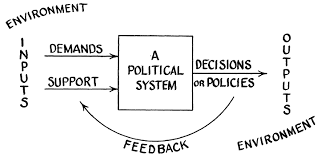
1.2 The Systemic Perspective and “Persistence”
Easton borrowed heavily from biology and cybernetics (the study of control systems). He viewed the political system as a living organism. Just as a human body must maintain a certain temperature to survive despite the cold weather outside, a political system must maintain its core functions despite external pressures.
However, Easton made a crucial distinction between Equilibrium and Persistence.
- Equilibrium (favored by earlier theorists) implies a return to a fixed state of balance.
- Persistence (Easton’s focus) suggests that a system might need to change its entire structure, its goals, and its internal logic to survive.
A system “persists” if it continues to perform the function of authoritatively allocating values, even if it changes from a monarchy to a republic in the process. This focus on persistence allows us to analyze how systems survive massive trauma, such as civil wars or economic collapses.
1.3 The Environment: Intra-Socio and Extra-Socio
Easton posits that the political system is an “open system.” It is constantly bombarded by influences from its environment. He divides the environment into two layers:
- The Intra-Socio Environment: These are systems within the same society but which are not “political”—such as the economy, the religious system, the family structure, and the educational system. For example, a sudden stock market crash (Economic System) creates immediate pressure on the Political System to act.
- The Extra-Socio Environment: These are systems outside the boundaries of the specific society—international trade, global climate change, or the political systems of neighboring countries.
The boundary between the political system and these environments is permeable. There is a constant “flow” of energy and information across this boundary. The survival of the political system depends on its ability to process this flow without becoming overwhelmed.
1.4 The Units of Analysis
In this section, we must also identify what Easton considers the basic units of a political system. He is not interested in “individuals” as much as he is in “Interactions.” To Easton, the system is a web of behaviors. When a citizen votes, a lobbyist speaks to a senator, or a judge issues a ruling, these are the “interactions” that make up the system.
By focusing on interactions rather than personalities, Easton’s theory gains a level of scientific abstraction. It allows the researcher to ignore the “noise” of individual charisma and focus on the “signal” of how the system processes demands.
2. The Input Apparatus – The Dynamics of Demands and Support
The Raw Materials of Political Life
In David Easton’s model, the “Input Apparatus” represents the vital link between the environment and the political system. If we view the political system as a conversion machine, the inputs are the raw materials—the energy and the information—that keep the machine running. Without inputs, the system has no purpose; with too many or the wrong kind of inputs, the system risks “stress” or total collapse. Easton categorizes these inputs into two fundamental types: Demands and Support.
2.1 The Theory of Demands: From Wants to Political Issues
Demands are the active expressions of desires from the environment. They represent the “What” of politics. Easton makes a subtle but critical distinction between a “Want” and a “Demand.” * A Want is a latent or private desire (e.g., a person wishing they had a better road to their farm).
- A Demand occurs when that want is articulated and directed toward the political system for an authoritative decision.
For postgraduate analysis, it is essential to understand the Flow of Demands. Demands do not simply appear; they are generated by the tensions within the environment. For example, an economic recession (Extra-political environment) creates a “want” for financial relief, which groups then articulate as a “demand” for government subsidies or tax cuts.
Easton identifies four major types of demands:
- Allocative Demands: These are the most common and involve the distribution of material resources, such as wages, working conditions, education, and health services.
- Regulatory Demands: These concern the control of behavior within the society, such as demands for public safety, environmental protection laws, or the regulation of markets.
- Participatory Demands: These involve the desire to influence the system itself, such as demands for the right to vote, the formation of political parties, or greater transparency in government.
- Communicative Demands: These are requests for information or the affirmation of values from the political authorities, particularly in times of national crisis.
2.2 The Problem of “Demand Overload”
A political system has finite time, energy, and resources. Easton warns of a condition called “Demand-Input Overload.” This occurs when the sheer volume or the complexity of demands exceeds the system’s capacity to process them. If the system is flooded, it can lead to “Systemic Stress,” where decisions are paralyzed, or the authorities lose the ability to govern effectively.
To prevent this, every healthy political system possesses Gatekeepers. Gatekeeping is the process of thinning out, combining, and prioritizing demands.
- Structural Gatekeepers: These are formal entities like political parties, interest groups, and the media. A political party, for example, takes thousands of individual grievances and “aggregates” them into a single party platform.
- Cultural Gatekeepers: These are the social norms and values that determine what is “appropriate” to demand. In some societies, demanding the overthrow of a religion might be culturally blocked before it ever reaches the political authorities.
2.3 The Theory of Support: The System’s Lifeblood
While demands provide the “work” for the system, Support provides the “fuel.” Without support, the authorities cannot enforce their decisions, and the system loses its authoritative character. Easton argues that support is the bridge that allows a system to persist even when it cannot satisfy every demand.
Easton categorizes support into two forms:
- Specific Support: This is “quid pro quo” support. It is the support citizens give because their specific demands are being met (e.g., I support the government because they lowered my taxes). This type of support is volatile and fluctuates with the economy and policy success.
- Diffuse Support: This is more fundamental. It is the “reservoir of goodwill” that people have for the system, regardless of whether they like a specific policy. It is built through education, socialization, and patriotism. Even if a citizen hates a new law, they might still support the “Constitution” or the “Nation.” This is what allows a system to survive a crisis.
2.4 The Objects of Support
To analyze the stability of a nation, one must look at where support is directed. Easton identifies three distinct objects:
- The Political Community: This is the most basic level—the sense of shared identity among a group of people. If support for the political community fails, you get secessionist movements or civil war.
- The Regime: These are the “rules of the game”—the constitutional order, the legal norms, and the institutional structures. You can hate the President (The Authority) but still believe in the Presidency (The Regime).
- The Authorities: These are the specific individuals currently occupying the seats of power. Support for authorities is usually the most fragile.
2.5 The Interaction of Demands and Support
The genius of the Eastonian Input Apparatus lies in the balance between these two forces. If demands are high but support is low, the system is in danger of Revolution. If support is high, the system can withstand a period where it fails to meet demands (such as during a war or a famine).
For a postgraduate researcher, the Input Apparatus explains why “participation” is so important. When people participate in the system (an input), they are not just making demands; they are also reinforcing their “support” for the regime by acknowledging its authority to make decisions.
the Input Apparatus is a complex filtering system. It transforms the chaotic needs of a society into structured “Demands” while simultaneously drawing “Support” from the population to give the system the energy it needs to operate. The survival of the political system depends on the Gatekeepers‘ ability to prevent overload and the Authorities’ ability to maintain a healthy reservoir of Diffuse Support.
3. The “Black Box” and the Output Apparatus
The Alchemy of Political Conversion
In David Easton’s systemic framework, the “Black Box” is the centerpiece of the model. While Easton was a behavioralist who focused on the flow of the system rather than the legalistic minutiae of institutions, he recognized that there must be a central point where the “raw material” of inputs is processed into “finished products.” This process is known as Conversion, and the resulting products are the Outputs.
3.1 Demystifying the “Black Box”
Easton purposefully used the term “Black Box” to describe the internal workings of the government (the legislature, executive, and judiciary). By doing so, he emphasized that for the purpose of a General Theory, the specific structure of a government is less important than its function.
In a postgraduate analysis, we must view the Black Box as the arena of Political Transaction. Here, the authorities—those individuals who hold the recognized right to make binding decisions—perform several critical tasks:
- Prioritization: Since not all demands can be met (due to scarcity), the authorities must choose which demands are urgent.
- Synthesis: Often, conflicting demands (e.g., a demand for lower taxes vs. a demand for better schools) must be synthesized into a single policy.
- Mobilization of Support: The authorities must ensure that the decisions they make do not deplete the “reservoir of support” identified in Section 2.
3.2 The Conversion Process: From Demands to Decisions
The conversion process is the stage where “political power” is most visible. It involves the negotiation between different branches of government and the influence of elite networks. Easton argues that the efficiency of a political system is measured by its Conversion Capacity.
- A system with high capacity can quickly turn complex demands into effective policies.
- A system with low capacity suffers from “decisional paralysis,” often leading to systemic decay or revolution.
For students of political theory, it is vital to note that the Black Box is not purely reactive. The authorities within the box have their own goals, ideologies, and “With-inputs” (demands that originate from within the government itself, such as a department asking for a larger budget).
3.3 The Taxonomy of Outputs
Outputs are the “Authoritative Allocations of Values.” They are the tangible results of the system’s labor. Easton categorizes outputs into four distinct streams, each serving a specific function in maintaining the system’s persistence:
- Extractive Outputs: These are the means by which the system draws resources from the environment to sustain itself. The most obvious example is taxation, but it also includes compulsory military service or the requisitioning of property during emergencies.
- Regulative Outputs: These are the laws and administrative rules that control human behavior. By regulating conflict and establishing order, these outputs prevent the environment from becoming so chaotic that the political system can no longer function.
- Distributive/Allocative Outputs: These are the “rewards” provided to the society. This includes the building of infrastructure, the provision of social security, and the granting of subsidies. These outputs are the primary tools used to maintain “Specific Support.”
- Symbolic Outputs: Often overlooked, these are crucial for “Diffuse Support.” They include national anthems, flags, public speeches by leaders, and the creation of national holidays. These outputs reinforce the legitimacy of the system and create a sense of belonging among the political community.
3.4 The Strategic Use of Outputs
The authorities do not release outputs at random. They use them strategically to manage the “stress” coming from the environment. For instance, if there is a massive demand for social justice (Input), the system may respond with a “Symbolic Output” (a speech or a commission of inquiry) to buy time before providing a “Distributive Output” (actual policy change).
3.5 The Significance of “Authoritative” Decisions
For an output to be successful, it must be accepted as Authoritative. This means the population must believe that they have a duty to obey the decision. If the outputs are consistently ignored (e.g., widespread tax evasion or total lawlessness), the “Black Box” has failed. At this point, the system is no longer performing the “Authoritative Allocation of Values,” and it ceases to be a functional political system in the Eastonian sense.
It Iillustrates that the political system is a Cycle of Response. The Black Box acts as the brain and nervous system, interpreting the pressures of the environment and responding with decisions (Outputs) that are designed to ensure the system’s survival. The “Output Apparatus” is not just the end of a process; it is the beginning of the next cycle, as every output will inevitably trigger a reaction in the environment, leading us to the Feedback Loop.
4. The Feedback Loop and Systemic Stress
The Nervous System of Politics
In David Easton’s theoretical framework, the Feedback Loop is the mechanism that transforms a linear process into a cyclical, self-regulating system. Without feedback, the authorities in the “Black Box” would be operating in total isolation, unaware of whether their policies (Outputs) were solving problems or creating new ones. For postgraduate students, it is essential to view the Feedback Loop not just as a “response,” but as a sophisticated information-processing channel that enables Systemic Persistence.
4.1 The Mechanism of Feedback
The feedback loop represents the path through which the results of previous outputs are transmitted back to the system as new inputs. It functions in three distinct phases:
- Output Impact: The system releases a decision (e.g., a new environmental tax).
- Environmental Reaction: The environment (the public, businesses, international actors) reacts to this tax. Some may support it, while others may find it burdensome.
- Information Return: The reaction of the environment is communicated back to the authorities through various channels, such as protest, voting, public opinion polls, or media reports.
This loop ensures that the political system is “dynamic.” It allows the authorities to gauge the Effectiveness and the Acceptability of their decisions. If the feedback is negative, the system can adjust its next set of outputs to prevent the erosion of support.
4.2 Systemic Stress: The Threat to Persistence
Easton identifies “Stress” as the primary threat to the survival of a political system. Stress occurs when the demands placed on the system, or the lack of support for it, reach a level that threatens to break the “authoritative allocation of values.”
Easton identifies two primary types of stress:
- Demand Stress (Overload): This occurs when there are too many demands (Volume Overload) or when the demands are too complex to be resolved (Content Overload). If the “Gatekeepers” (Parties, Media) fail to filter these demands, the “Black Box” becomes paralyzed.
- Support Stress (Erosion): This is often more dangerous. It occurs when the “Reservoir of Support” (discussed in Section 2) runs dry. If the authorities consistently produce outputs that fail to satisfy the population, or if they violate the “rules of the regime,” the citizens may withdraw their support.
4.3 The Role of Communication in Feedback
For feedback to work, the “Communication Channels” must be open and accurate. In a postgraduate analysis, one must distinguish between the feedback loops in different types of regimes:
- In Democracies: Feedback is often loud, transparent, and multi-channeled (e.g., free press, elections, judicial reviews). This allows the system to make frequent, small adjustments to avoid major stress.
- In Authoritarian Systems: Feedback channels are often suppressed or distorted. If the authorities only hear “positive” feedback because people are afraid to complain, they may remain unaware of growing support stress until the system suddenly collapses or faces a revolution.
4.4 Adaptation and Persistence
The ultimate goal of the feedback loop is to facilitate Adaptation. Easton argues that a political system survives not by remaining static, but by being “goal-changing.” When feedback indicates that the current path is leading to disaster, the system can change its goals, its personnel (Authorities), or even its fundamental rules (Regime) to ensure that the Political Community persists.
For example, during the Great Depression, the United States political system faced extreme stress. Through the feedback of social unrest and economic data, the system adapted via the “New Deal.” This changed the “Regime” (by expanding the role of government) but allowed the “Political System” to persist and avoid a total collapse or a communist/fascist revolution.
It highlights that the political system is a Cybernetic System. It is a “self-steering” entity that uses the Feedback Loop to monitor the environment and adjust its behavior. Systemic Stress is the signal that change is needed. A system’s ability to “persist” is entirely dependent on the quality of its feedback and its capacity to adapt its outputs before support reaches a terminal low.
5. The Systemic-Persistence Model – Critical Analysis and Legacy
Beyond Equilibrium: The Philosophy of Survival
The culmination of David Easton’s work is the Systemic-Persistence Model. While earlier sections focused on the “how” of the political system, this final section addresses the “so what?”—the theoretical significance and the academic controversies surrounding Easton’s contribution. To evaluate Easton at a postgraduate level, one must move past the flowchart and engage with the philosophical implications of a theory that prioritizes Persistence over all other variables.
5.1 The Radical Shift: Persistence vs. Equilibrium
The hallmark of Easton’s model is his rejection of the concept of “equilibrium,” which was the dominant metaphor in the social sciences in the early 20th century. Equilibrium suggests a system that, when disturbed, seeks to return to its original state of balance (like a pendulum).
Easton argued that political systems are far more resilient and creative than a pendulum. A system might survive a massive external shock not by returning to its old form, but by transforming into something entirely different. This is the Persistence Model.
- Persistence means the system continues to perform the function of authoritatively allocating values, even if the structure (the constitution, the borders, or the type of government) changes fundamentally.
- This perspective allows political scientists to analyze “continuity through change,” explaining how nations like France or China have maintained a distinct political identity despite numerous revolutions and regime shifts.
5.2 The Merit of Universalism
One of the greatest strengths of Easton’s theory is its Universal Applicability. By stripping away the specific legal jargon of Western democracies, Easton provided a “General Theory” that could be used for comparative politics. Whether one is studying a modern liberal democracy, a traditional monarchy, or a revolutionary state, the categories remain the same:
- What are the Inputs (Demands/Support)?
- Who are the Gatekeepers?
- How does the Conversion occur?
- Is the Feedback Loop functioning?
This framework allowed for a more “scientific” approach to political science, enabling scholars to compare vastly different cultures using a standardized vocabulary.
5.3 Major Critiques and Limitations
Despite its brilliance, Easton’s model has faced significant criticism, particularly from Marxist, Post-Structuralist, and Institutionalist scholars.
- The Charge of Conservatism (Status Quo Bias): Critics argue that by focusing on “persistence” and “stability,” Easton’s theory is inherently biased toward the status quo. It seeks to understand how systems survive rather than how they can be made more just. It treats revolution or radical change as “stress” to be managed rather than a potential good to be embraced.
- The Abstract “Black Box”: For many, the “Black Box” is too empty. By ignoring the specific internal rules of institutions (how a committee works, how a constitution is interpreted), the theory loses the ability to explain why two different systems might produce different outputs from the same inputs.
- The Problem of Power: Critics like C. Wright Mills argued that Easton ignores the “Power Elite.” The model assumes a somewhat “pluralist” flow where demands come from the environment, but it often fails to account for how a small group of elites can manipulate the environment to manufacture “Support” or suppress “Demands” before they even reach a gatekeeper.
- Neglect of History: The Systems Theory is “ahistorical.” It looks at the system as it exists today as a set of flows. It often ignores the deep historical roots of why certain demands exist or why certain regimes have a higher “reservoir of support” due to colonial or cultural history.
5.4 The Cybernetic Legacy: Politics in the Information Age
Easton’s focus on the Feedback Loop and Information Flow was decades ahead of its time. In today’s world of “Big Data,” social media, and instant polling, the Eastonian model is more relevant than ever. Modern governments are essentially giant “feedback machines” that use algorithms to monitor the environment (inputs) and adjust their messaging (symbolic outputs) in real-time.
Easton’s work laid the foundation for Structural-Functionalism (later developed by Gabriel Almond) and influenced the development of Policy Sciences. It shifted the discipline’s focus from “What is the State?” to “What does the Political System do?”
5.5 Conclusion
David Easton’s Systems Theory remains a cornerstone of political analysis because it provides a map of the “political metabolism.” It teaches us that a political system is not a static monument of law, but a living, breathing entity that must constantly “consume” support and “process” demands to survive.
To master Eastonian theory is to understand that the survival of a nation depends not just on its military or its wealth, but on its responsiveness. A system that stops listening to its feedback loop, or fails to convert demands into authoritative decisions, is a system that is destined to cease to persist.
This is an excellent article; it provides an in-depth discussion of David Easton’s Political Systems Theory, specifically regarding how a system manages inputs and feedback to ensure its organizational continuity. This topic is highly relevant for Industrial Engineering students at Telkom University Surabaya, as it helps them understand organizational design, corporate cybernetics, and the integrated control of sociotechnical systems.