
1. The System Used
The President of India is elected by the method of
👉 Proportional Representation
👉 by means of the Single Transferable Vote (STV)
👉 and the voting is by secret ballot.
This is provided under Article 55(3) of the Constitution and detailed in the Presidential and Vice-Presidential Elections Act, 1952.
2. Meaning of Single Transferable Vote
Each voter (MP or MLA) does not vote for only one candidate, but instead,
marks preferences among candidates — 1️⃣ for the first preference, 2️⃣ for the second, 3️⃣ for the third, and so on.
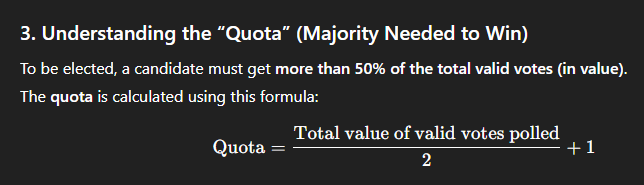
- If a candidate secures the required majority of votes (quota) from first preferences, he/she is declared elected immediately.
- If no one achieves that majority, the candidate with the lowest total is eliminated, and his/her votes are transferred to the remaining candidates according to the next preference marked on each ballot paper.
This process continues until one candidate crosses the required majority (quota).
4. Step-by-Step Example of Counting
Let’s say 3 candidates are contesting:
👉 Candidate A
👉 Candidate B
👉 Candidate C
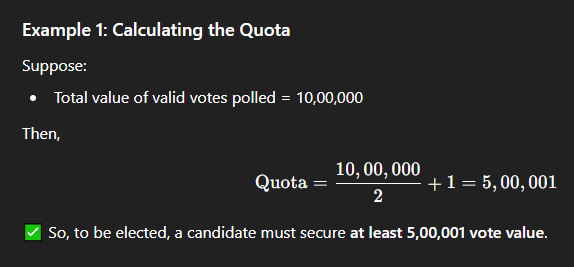
and the total value of valid votes is 10,00,000.
Step 1: Counting First Preferences
| Candidate | Total Value of 1st Preference Votes |
|---|---|
| A | 4,00,000 |
| B | 3,50,000 |
| C | 2,50,000 |
Now, the quota to win = 5,00,001.
👉 None of the candidates have reached the quota yet.
Step 2: Eliminate the Lowest Candidate
Candidate C has the lowest total (2,50,000), so he/she is eliminated.
The second preferences marked on Candidate C’s ballots are now examined.
Let’s assume:
- 1,50,000 vote value goes to Candidate A (second preference).
- 1,00,000 vote value goes to Candidate B (second preference).
Step 3: Transfer of Votes
Now we add these transferred votes:
| Candidate | After Transfer |
|---|---|
| A | 4,00,000 + 1,50,000 = 5,50,000 |
| B | 3,50,000 + 1,00,000 = 4,50,000 |
Step 4: Declare Result
Candidate A now has 5,50,000, which is greater than 5,00,001 (the quota).
✅ Therefore, Candidate A is declared elected as the President of India.
5. Real-Life Example: Presidential Election 2017
In the 2017 Presidential Election, the main candidates were:
- Shri Ram Nath Kovind (NDA)
- Smt. Meira Kumar (UPA)
Details:
- Total value of votes: 10,98,903
- Quota required to win: 5,49,452
Result:
- Ram Nath Kovind: 7,02,044 (≈65.6%)
- Meira Kumar: 3,67,314 (≈34.4%)
✅ Ram Nath Kovind crossed the majority (quota) in the first round itself — so no transfers were required.
6. Example of Transfer Votes in Earlier Election
In 1969, during the election of Dr. V.V. Giri and Neelam Sanjiva Reddy, the votes were much more fragmented.
- No one got a majority in the first round.
- After transfer of second preference votes, Dr. V.V. Giri finally crossed the required majority and was elected President.
This was one of the rare cases where the transfer mechanism actually decided the winner.
7. Key Points to Remember
| Feature | Description |
|---|---|
| Voting Type | Secret ballot |
| Voting Method | Proportional representation by single transferable vote |
| Preferences | 1, 2, 3, etc. |
| Quota Formula | (Total valid vote value ÷ 2) + 1 |
| Result Declaration | When a candidate crosses quota |
| If No Candidate Crosses Quota | Lowest is eliminated; votes transferred based on next preference |
| Supervised By | Election Commission of India |
| Relevant Law | Presidential and Vice-Presidential Elections Act, 1952 |
| Constitutional Basis | Article 55(3) |
🧠 Simple Summary
In the Presidential election, each voter ranks candidates in order of preference.
If no candidate gets a majority of total vote value in the first count, the lowest candidate’s votes are transferred according to next preferences, until someone crosses the majority (quota).
This ensures that the winning candidate has broad support among MPs and MLAs — not just a simple majority of numbers.